
Past events
- Critically Engaging Participatory Action Research (recording available)
- Everyday ethics in participatory research with migrants (slides available)
- PhD Building Blocks: Participatory research – critical perspectives (recording available)
- What is ‘research’ – the view from the margins (recording available)
- Co-production across cultural contexts (slides available)
- Building equitable collaborations: Power dynamics in participatory research and practice
- Experts know best? Lived experience and the eradication of child poverty in Scotland (recording available)
- New ethics for new times (recording available)
- Network Launch
Critically Engaging Participatory Action Research
Webinar | 3rd November 2025 19:00-20:30
Please click here to watch the recording of the webinar.
In this latest webinar, co-editors of the recent book Critically Engaging Participatory Action Research (2024) share their thoughts on why the ‘critical’ dimension is vital as PAR becomes mainstreamed in social science research around the world. They will then invite discussion on how we can practice an ongoing commitment to a reflexive, collaborative politics that works in solidarity with minoritised others towards epistemic, social and political justice.

Everyday ethics in participatory research with migrants
Seminar | 27 June 2025 12:00-13:30 (online)
On the Margins is organising an online seminar ‘Everyday ethics in participatory research with migrants’, which will include a series of presentations from academics and practitioners.
Amidst a growing interest in participatory research in recent years, ethics has emerged as an important topic of discussion within the existing literature. As a specific form of engagement and practice, participatory research has been described as an inherently complex process that necessitates greater consideration of ethical issues in practice and generally requires more ‘ethics work’ on the ground (Banks 2016). While participatory methods are often being used in research involving migrants, the burgeoning literature on ‘everyday ethics’ has developed largely in isolation from critical debates within migration studies and other relevant fields. This seminar aims to fill this gap by critically exploring the ‘everydayness’ of ethics in the context of research involving migrants.
- What does it actually mean to do research ‘not on but with’ migrants?
- What does a genuine participation/collaboration look like in practice?
- How can ethics and marginality be successfully negotiated in everyday contexts?
- How does negotiation of ethical issues vary across different migrant groups or across different countries/contexts?
- What are the uses (and abuses) of participatory methods within migration research?
- What are the latest innovations (in both social sciences and arts/humanities) in participatory research with migrants?
- How can critical migration research inform wider debates around co-production and decolonisation of knowledge?
- How can participatory methodologies and ethical approaches developed beyond Northern/Eurocentric perspectives inform migration research?
You can download the presentations below:
‘Building bridges between idealism and restriction: learning from participatory practice with migrant, refugee and indigenous background young people in urban Jordan’
Dr Sarah Linn, Manchester Metropolitan University, Abdallah Abolouz and Dr Hala Ghanem, Hashemite University
‘Negotiating consensus: Competing demands in co-produced research with refugees, people seeking asylum and migrants’
Dr Chantal Radley and Dr Eglė Dagilytė, Anglia Ruskin University
‘Sociability and Care in Participatory Research: Photovoice with Refugees and People Seeking Asylum in North West England’
Dr Megan Crossley, Lancaster University
PhD Building Blocks: Participatory research – critical perspectives
Webinar | 14 May 2025 14:00-16:00
Please click here to watch the recording of the webinar.
This session, led by Dr Taulant Guma, co-convener of On the Margins, provided a critical perspective on participatory methods and how PhD students can apply them in practice. The session is part of the PhD Building Block series organised by the Scottish Graduate School of Social Sciences for first-year PhD students.


What is ‘research’ – the view from the margins
Webinar | 20 January 2025 at 4.30 pm
Please click here to watch the recording of the webinar.
In academia research is defined as any form of ‘disciplined inquiry’ or ‘process of investigation’ that produces new knowledge or insights and includes work that is of ‘direct relevance’ to the society. Yet organisations, groups and individuals who engage in research activities with or outside academia may see, use or value research in different ways. For example, as the indigenous author Linda Tuhiwai Smith has shown, her participants saw (Western) research not as a ‘process of investigation producing new insights’ but as a ‘dirty’ word and a ’dehumanising’ practice.
In this webinar we problematised the idea of ‘research’ approaching it from the perspective of participants and practitioners representing grassroots groups and organisations.
Co-production across cultural contexts
International seminar, Edinburgh, Edinburgh Napier University Merchiston Campus | 7 January 2025, 12-5pm
This international seminar explored how local and national contexts shape participatory research and knowledge co-production. It involved academics and activists sharing experiences of doing participatory research across different countries including UK, Finland, and Poland.
The seminar was a collaboration between “On the Margins” and Faculty of Social Sciences at University of Helsinki. It took in person at Edinburgh Napier University, Merchiston Campus.
Programme
12:00 – 12:15 Arrival
12:15 – 1:00 Lunch
1:00 – 2:00 Presentations – Finland
‘Co-research, co-production of knowledge, collaboration or being an academic ally – how to conceptualise different forms of working together with non-academic individuals, groups and organisations.’
Dr Reetta Mietola, University of Helsinki
‘Overcoming barriers to democratic participation with minoritized
and marginalized groups – a participatory project.’
Dr Meri Kulmala & Dr Reetta Mietola, University of Helsinki
‘Co-research as a research strategy to study peer support for
mental health in social media.’
Dr Anna-Maija Multas, Dr Liinu Vento & Dr Meri Kulmala, University of
Helsinki
2:00 – 2:20 Presentations – Poland
‘Trans liberation, trans* embodiments, and decentring radical praxis in Poland.’
Dr Toni Kania, Edinburgh Napier University.
2:20 – 3:00 Presentations – UK
‘From sequins to sewing: using arts-based methods to empower research participants with lived experience of sexual violence in England.’
Dr Laura Bower, Edinburgh Napier University
‘Co-designing and co-producing research with asylum seeking community in Glasgow, Scotland.’
Dr Taulant Guma (Edinburgh Napier University) and Yvonne Blake (MORE)
3:00 – 3:30 Coffee break
3:30 – 5:00 Panel discussion
5:00 Close

Building equitable collaborations: Power dynamics in participatory research and practice
Webinar | 23 September 2024 at 4.30 pm
All forms of engagement have a purpose but not all forms of engagement are equitable. In this webinar, curator and anti-racist activist Zandra Yeaman reflects on her experiences of leading the collaborative project: Curating Discomfort. The project aimed at exploring ways of making museums more inclusive spaces and developing new forms of collaboration between community groups, professionals and academics. Zandra has worked with the Hunterian, the oldest public museum in Scotland (1807), to gain an understanding of its slavery and colonial legacies, offering a series of interventions that take the museum and its practices out of the institutional comfort zone.
In her talk, Zandra will critically reflect on the power dynamics that emerged in this collaborative project at different levels and in its various stages. She will also share details of a new Participatory Framework developed at the Hunterian aimed at creating a common understanding of what we mean when we use terms of engagement in our practice.


Experts know best? Lived experience and the eradication of child poverty in Scotland
A critical reflection on practice
Webinar | 22 April 2024, 4.30pm
Please click here to watch the recording of the webinar.
This webinar looked at participation and empowerment in collaborative resesarch, focusing specifically on the involvement of ‘experts by experience’ in the co-production of policy and service development within a Scottish context. We are delighted to have Prof John McKendrick who is Professor in Social Justice at Glasgow Caledonian University joining us for this webinar. In his talk, John will reflect on the aspiration of embedding the role of lived experience in action to tackle child poverty in Scotland, focusing on both national and local work, and principles and practice. John’s presentation will be followed by an online discussion and Q&A.
John’s main research interests lie in poverty (with a particular interest in children) and children’s play and has published for both academics and practitioners. He is particularly keen that his work is of use to practitioners and campaigners beyond the academy who seek to tackle poverty in Scotland, the UK and the EU. He has written extensively on these issues including co-editing the following volumes/books “Poverty in Scotland 2016 (CPAG, 2016), “Co-Production Involving ‘Experts with Lived Experience of Poverty’ in Policy and Service Development in Scotland” , (SPIRU 2021), and “Poverty in Scotland 2021: Towards a 2030 Without Poverty” (CPAG 2021). He is the co-director of the Scottish Poverty and Inequality Research Unit (SPIRU) and has been on Play Scotland’s Board of Directors since 1997. More recently, in 2023 John was appointed Scotland’s new Commissioner for Fair Access.This webinar discusses empowerment in collaborative research.
New ethics for new times
Online workshop | 29th January 2024 @4.30pm
Please click here to watch a recorded version of the workshop.
This workshop looked at the changing context for participatory action research (PAR) and the implications for ethical practice. PAR entails people with lived experience of the issue to be researched playing an active role in designing and conducting the study, sometimes in partnership with academics or other ‘professional’ researchers, with the aim of bringing about positive change.
In many countries PAR is becoming more popular, moving from the margins towards the mainstream. At the same time the growth of digital technologies provides opportunities for extending the reach of PAR, with possibilities for global networks and greater inclusion of people previously not reached, while also excluding those without access to technology.
This context provides scope for the principles and practices of PAR to influence mainstream research agendas. Yet it also increases the threat of co-option and dilution of PAR as participatory methods and techniques are applied without being embedded in commitment to, and competence in, a more holistic and value-based PAR approach.
- How do we handle these challenges and tensions in our everyday practice?
- Are institutional ethics review processes a help or hindrance and how can we improve them?
The workshop aims to answer these and other questions in relation to ethics in PAR. It will be led by Prof Sarah Banks from the University of Durham. Sarah’s research focuses on professional ethics, community development and community based participatory research, areas around which she has published and presented extensively. Her more recent work includes the following edited volumes: Ethics, Equity and Community Development; Co-producing Research; and Ethics in Participatory Research for Health and Social Well-Being.


Network Launch
Edinburgh Napier University, Sighthill Campus Monday 27th November
We are delighted to announce the launch of “On the Margins” on Monday 27th November 2023.
“On the Margins” is a Collaborative Research Network that brings together academics, practitioners and activists interested in participatory and collaborative research and knowledge co-production, with specific focus on marginalised groups and communities.
Participatory or collaborative research – i.e. research ‘not on but with’ those individuals and communities whose livelihoods are being studied – has developed as an alternative to the more ‘traditional’ ways of doing research. It is a specific and well-meaning form of engagement and practice that aims to democratise the research process and challenge the power imbalances inherent in it. Often participatory research is being used in projects involving vulnerable and marginalised groups, where these power dynamics are even more pronounced.
“On the Margins” aims to address these power imbalances and remove barriers that exist within participatory research. It will do so by organising a series of events and activities engaging academic and non-academic community with the aim of developing new ways of working together. The Network offers an inclusive and empowering space allowing practitioners and activists working with or representing people on the margins of society to discuss research ideas openly and engage with academics as equal partners in research and knowledge production.
To find out more about “On the Margins” network, how to participate in it and contribute to its activities, please come and join us on 27th November!
Programme
Venue: The Horizon Suite (LRC5), Sighthill Campus, Edinburgh Napier University
Time: 14.00-17.00, Monday 27th November
2.00 – 2.10 Arrival and coffee
2.10 – 2.15 Welcome – Gary Hutchison, Dean of School of Applied Sciences, ENU
2.15 – 2.25 Introduction – Taulant Guma & ‘On the Margins’ team
2.25 – 2.35 Spoken word, “All Alone Together” – ACE V!S!ON
ACE V!S!ON (They/He) is a Scottish-Malawian poet and active rapper/musician who is equally as comfortable communicating freestyle/spoken word on open-mic stages as they are lacing eloquent rhyme with experimental rhythms, often inspired by themes of grief, loss and the universal human condition. ACE creates and releases their own music and pieces independently, as well as part of several local bands and collectives in and around Glasgow. As a queer-identifying POC, they frequently collaborate with groups and organisations involved in social justice activism & community care through creativity. They recently became a published playwright, shared work at the Edinburgh International Festival and Fringe, and is currently a recipient of Counterflows Music Space bursaries 2023–24.
2.35 – 3.10 Collaborative research presentations
- “Encountering trauma: on co-creation and queer politics in over/exposed” – Regina Mosch, ENU & Bee Asha, Spit It Out Project
- “Everyday experiences of housing during Covid times: a collaborative project with asylum seekers living in Glasgow” – Taulant Guma, ENU & Yvonne Blake, MORE
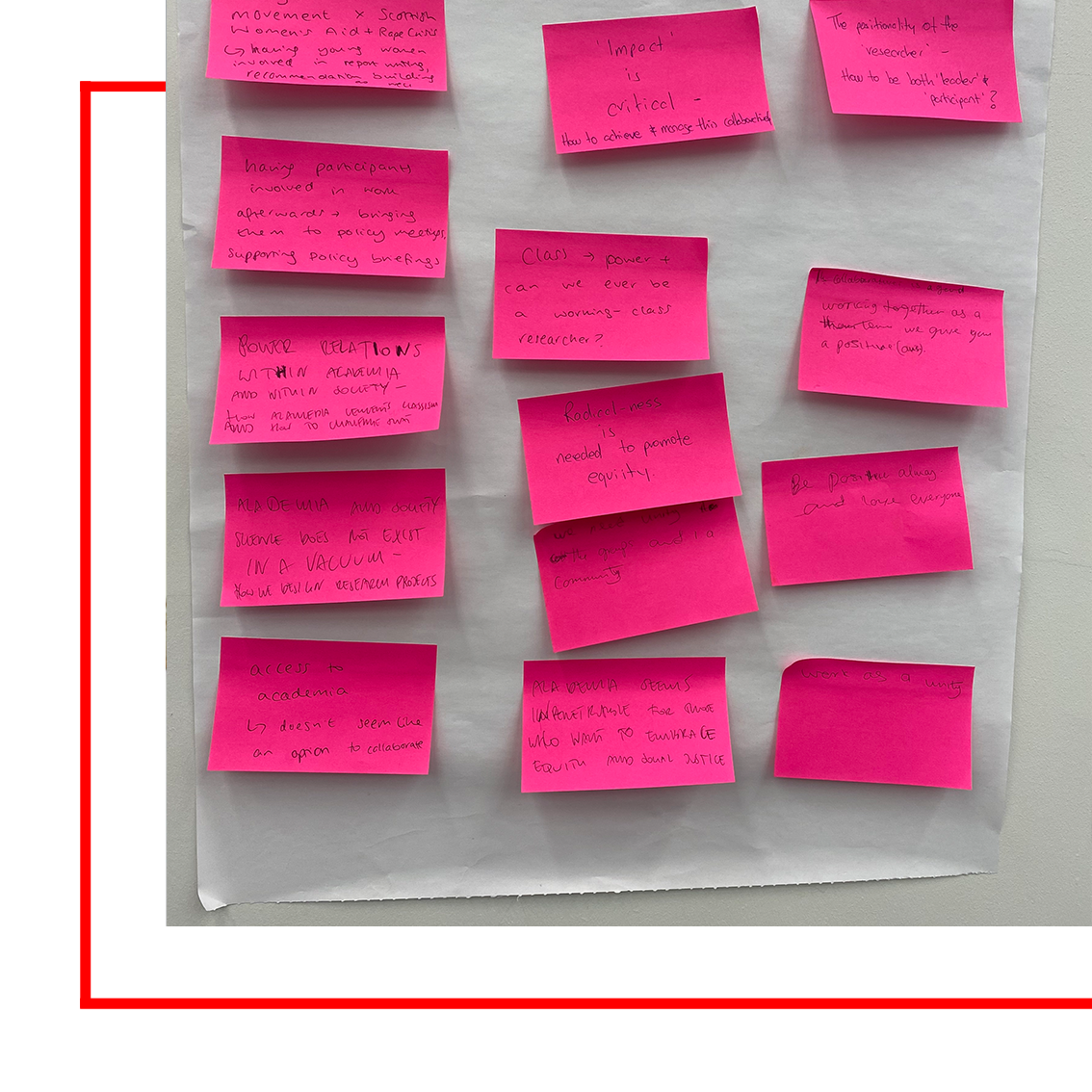
3.10 – 4.10 Workshop – “What makes a ‘good’ collaborative research”
4.10 – 4.30 Reflections and plans forward
4.30 – 5.00 Food and networking
5.00 Close
 On the Margins